
This is Article 7 in an ongoing series examining America's abandoned and orphaned well problem.
This installment looks at what physically moves through legacy wells during the years and decades of regulatory deferral that the earlier articles described.
How the issue is discovered
Most abandoned wells aren't discovered because regulators are looking for them. They're discovered because something ordinary doesn't add up. A utility contractor flags methane during a building inspection. A groundwater sample collected for a property transfer comes back wrong. A trench for a fence line or foundation turns up scale and stained material that nobody knew was there.
In property transactions tied to Phase II investigations, methane is sometimes detected away from any mapped well location, often along shallow utility corridors where gas can accumulate. The original wells were undocumented, or assumed to have been properly abandoned decades earlier. In most cases, there's been little to no post-closure monitoring.
Discovery is incidental rather than targeted, and often not expected at all. That pattern matters because it explains why leakage is usually found late, after pathways form and often after responsibility gets messy.
A background assumption that no longer holds
Article 6 showed how risk-based triage governs which wells receive attention. It's effective when the job is allocating limited resources to visible hazards, but it doesn't monitor quiet systems.
The working assumption has been simple. Once a well is plugged and labeled abandoned, it's effectively out of play unless something shows up at the surface. Oversight ends, records close, and attention shifts elsewhere.
Over decades, that assumption breaks down. Barrier materials degrade, pressure conditions change, and wells sit unmanaged through multiple ownership cycles. None of that is rare. None of it requires a sudden failure either. It only requires time. When leakage happens, it's rarely discovered by inspection. It shows up when migration intersects ordinary land use.
Mechanism: what physically or systemically fails
Methane
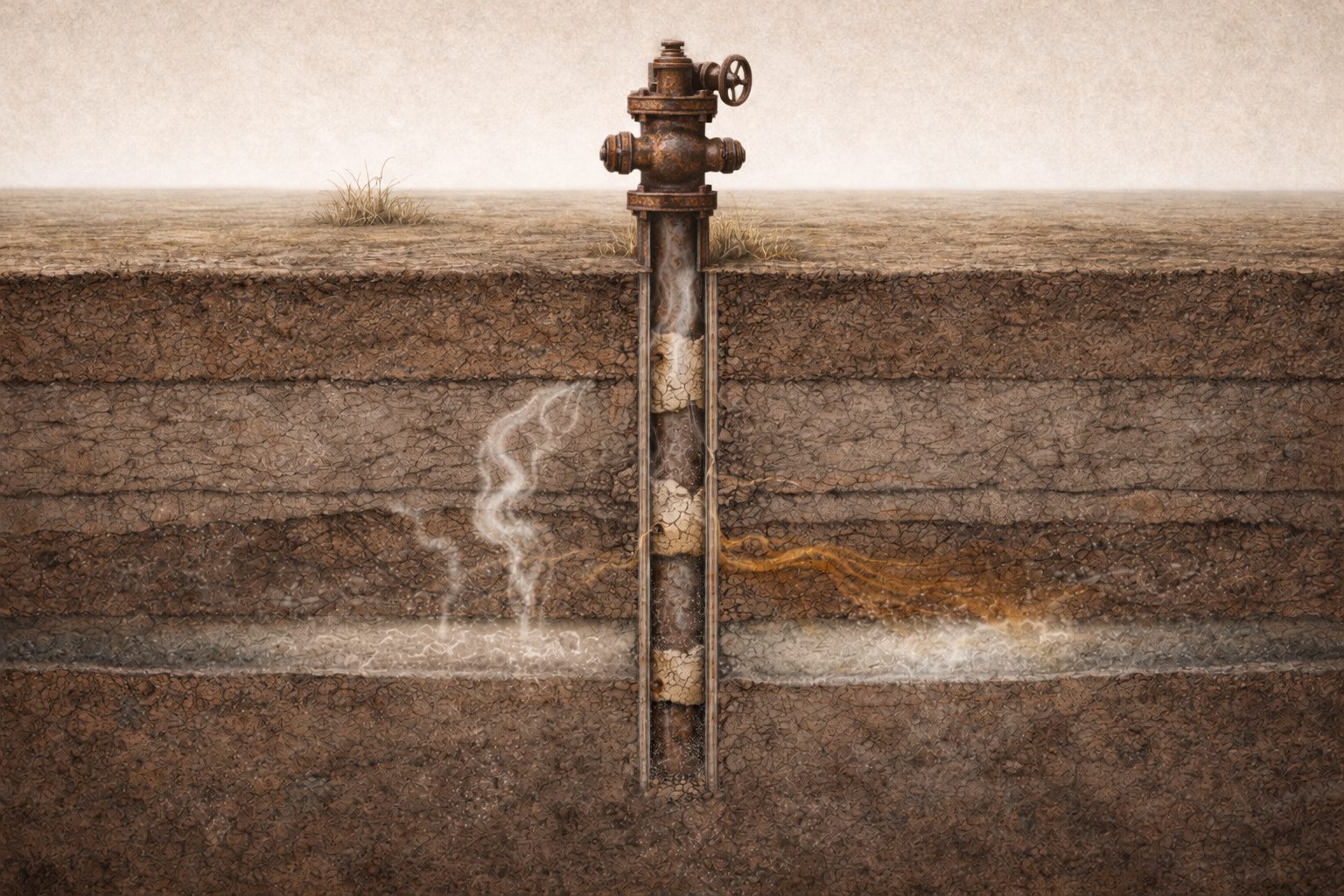
Methane moves when there's pressure and a path. Compromised cement, corroded casing, or micro-annular spaces can transmit very little for years. Once pressure conditions change, those same pathways may begin moving gas upward, often outside the original wellbore.
Migration rarely vents at the wellhead. Gas follows the path of least resistance until it encounters something unintended, such as a basement, a utility trench, or a confined space beneath a slab.
Most documented detections are point-in-time measurements rather than time-integrated flux. They confirm a pathway, but they don't characterize long-term emission rates. Seasonal groundwater levels, surface disturbance, and pressure fluctuations all matter. That variability is one reason abandoned-well methane can look sporadic and hard to square with inventory estimates.
Benzene
Benzene is usually a liquid-phase problem. Residual hydrocarbons or produced fluids can migrate once isolation is compromised, especially where fractures or degraded cement interfaces provide a connection to shallow groundwater.
Discovery typically occurs during domestic well testing or lender-required sampling. By the time benzene is detected, the source conditions may date back years or decades, because sampling captures presence rather than timing. Concentrations often reflect dilution and transport more than the original release, which complicates attribution and response.
Radium
Radium behaves differently. In most documented cases, it's encountered in solid-phase materials rather than migrating fluids. It concentrates in produced-water scale, contaminated soils, and sediments associated with historical handling or disposal practices.
Discovery often happens during excavation, whether for foundation work, agricultural disturbance, or remediation, when material that was never tracked is suddenly exposed. In these cases, radium isn't actively migrating. It was already there.
Evidence from field observations
Field evidence is dominated by isolated detections rather than continuous monitoring: a methane alarm during a renovation, a groundwater exceedance during a property transfer, elevated radioactivity identified only after soil is disturbed.
Reported measurements can span orders of magnitude, and an absence of detection often reflects an absence of sampling rather than confirmed integrity. That doesn't mean the problem is rare. It means discovery is opportunity-driven rather than systematic.
Why this failure is hard to detect or attribute
Leakage pathways frequently bypass the wellbore, eliminating obvious surface indicators. Time delays between failure and discovery obscure causal links, baseline data rarely exist, and jurisdiction is fragmented across oil and gas regulators, environmental agencies, and private parties.
By the time impacts are identified, the well may have moved from inactive to orphan status. That shifts responsibility away from operators and toward landowners or public programs, which is exactly the liability drift Article 5 described. None of this requires bad actors. It follows directly from delayed discovery in systems that don't get post-closure monitoring.
Implications for liability and remediation
Because detection is incidental and late, landowners often bear the initial burden. Testing and documentation usually come first, then temporary mitigation, then the consultant and legal work, long before responsibility is sorted out. Even when regulators intervene, the first steps are usually privately funded.
What matters is not only that leakage occurs, but when it's discovered. Timing determines whether remediation is treated as an operator obligation, a state responsibility, or a private dispute. Risk-based triage prioritizes visible hazards, but it can't prevent quiet migration during the years or decades before anything becomes visible.
Why proximity matters
Leakage from abandoned wells is most often identified by proximity rather than inspection. Because discovery depends on where people live, build, and transact property, landowners become the de facto monitoring system for legacy oil and gas infrastructure, without authority, training, or compensation. In practice, legacy wells are often discovered not by design, but because someone happened to live, build, or buy property nearby.
Next in the series:
Landowners as Monitors: How Proximity Drives Discovery
Sources and Further Reading
These are starting points; the literature varies by basin and by era of well construction.
-
Kang, M., et al. (2016). Direct measurements of methane emissions from abandoned oil and gas wells in Pennsylvania. PNAS.
-
Townsend-Small, A., et al. (2016). Isotopic measurements of methane emissions from abandoned wells. Environmental Science & Technology.
-
U.S. EPA (2003). Technologically Enhanced Naturally Occurring Radioactive Materials (TENORM) in the Oil and Gas Industry.
-
National Academies of Sciences (2023). Orphaned and Abandoned Wells.